
National News
Transforming Delta State Beyond The Imagination Of Naysayers: The Sheriff Oborevwori Legacy


Politics is often a theatre of predictions, assumptions, and premature judgments. Rarely does any leader assume office without being confronted by skeptics who question both capacity and vision. Such was the political atmosphere that greeted the emergence of Governor Sheriff Oborevwori as Governor of Delta State. There were those who doubted his preparedness, those who dismissed his political pedigree, and those who predicted that his administration would merely coast on the achievements of previous governments without charting a distinct course. Today, those early predictions have steadily collided with reality.
Rather than becoming overwhelmed by the burden of expectations, Governor Oborevwori quietly but steadily demonstrated that leadership is ultimately measured not by loud rhetoric but by measurable impact. In no time his administration evolved into one driven by practical governance, infrastructural expansion, economic inclusion, and social investment. The “MORE Agenda,” initially dismissed in some quarters as another political slogan, has increasingly become a governance philosophy evident across the numerous sectors of Delta State.
History teaches that transformational leaders are seldom recognized immediately. Their legacies are often built brick by brick, policy by policy, and project by project until the evidence becomes too overwhelming to ignore. In Delta State, Governor Sheriff Oborevwori is writing precisely that kind of story.
One of the strongest indicators of serious governance remains infrastructure. Roads are not simply strips of asphalt; they are economic arteries through which commerce, healthcare, education, and social interaction flow. Under Governor Oborevwori, Delta State has witnessed an aggressive continuation and expansion of road construction, rehabilitation, and urban renewal projects that are reconnecting communities long isolated by poor infrastructure.
Across the Three Senatorial Districts, construction activities have become increasingly visible. Communities that previously battled impassable roads now witness improved accessibility. Beyond easing transportation, these projects stimulate local economies by attracting businesses, increasing property values, and reducing transportation costs for farmers and traders. Infrastructure, when strategically deployed, becomes an instrument of economic liberation, and this understanding appears central to the administration’s development philosophy.
Healthcare has similarly received renewed attention. Quality healthcare remains one of the most important indicators of responsive governance because it directly affects the quality of human life. Investments in hospitals, primary healthcare centres, medical equipment, and personnel reflect a government conscious that development begins with healthy citizens. Improved healthcare delivery particularly benefits rural communities where access to medical services has historically been limited, and this commitment is one of the beacons of the Oborevwori Legacy.
Education remains another defining pillar of sustainable development. A State that neglects its educational system mortgages its future. Governor Oborevwori’s administration is huge on education, as the government continues to invest massively in school infrastructure, educational facilities, and policies aimed at creating better learning environments for Delta’s children. While challenges remain, the Oborevwori trajectory defines a government committed to strengthening the foundations upon which future generations must grow. To Governor Sheriff Oborevwori, Delta State Children MUST Go To School, and the Schools MUST be good enough to impact Students Positively.
Need I mention the boisterous Support System for Students in Tertiary Institutions, Delta State has about the most liberal academic support mechanism in Nigeria, under Governor Sheriff Oborevwori, Students Bursary, Scholarship Schemes, Empowerment and Skill Acquisition Projects, as well as Students Loan are met with unparalleled commitment and dispatch. And the many State owned Institutions enjoy the timely support of government in the areas of Funding, Staff Welfare and Infrastructure.
Economic empowerment forms another significant dimension of the Oborevwori legacy. Governance in the twenty-first century demands more than constructing physical infrastructure. It requires creating opportunities for citizens to participate meaningfully in economic growth. Various empowerment programmes targeting youths, women, entrepreneurs, artisans, and small businesses have been initiated and funded to stimulate enterprise while reducing unemployment.
The importance of these initiatives extends beyond immediate financial assistance. They represent investments in human capacity, encouraging innovation, entrepreneurship, and self-reliance. Every successful small business created today becomes tomorrow’s employer, taxpayer, and contributor to economic stability.
Youth development deserves special mention because no society can achieve lasting prosperity while neglecting its youthful population. Delta State possesses one of Nigeria’s most vibrant youth demographics. Recognizing this reality, the administration has increasingly focused on skills acquisition, vocational training, entrepreneurship support, and youth engagement initiatives designed to prepare young people for a rapidly changing economy.
Rather than viewing young people merely as political supporters, the government increasingly recognizes them as strategic partners in development. This shift in governance philosophy carries profound implications for the State’s long-term economic competitiveness.
Women have equally benefited from programmes promoting inclusion, empowerment, and economic participation. Around the world, evidence consistently demonstrates that societies prosper when women receive greater opportunities to contribute economically and socially. Policies supporting female entrepreneurship, social welfare, and inclusive governance strengthen not merely households but entire communities.
Perhaps one of Governor Oborevwori’s greatest political strengths lies in his relatively calm leadership style. In an era where political drama often overshadows governance, he has largely chosen performance over publicity. This understated approach has enabled the administration to concentrate on project execution rather than political theatrics.
Leadership should never be mistaken for constant media appearances. Sometimes the most effective leaders are those whose accomplishments speak louder than their speeches. In Delta State, visible projects increasingly constitute the Governor’s strongest political communication.
Critics naturally remain an essential component of every democracy. Opposition strengthens governance by demanding accountability and encouraging better performance. However, criticism becomes far less persuasive when objective evidence increasingly contradicts negative narratives, and such is the case with Delta State, in Delta State the Street cliche… ‘Governor Sheriff Dey Work, We Dey See Am’ is the unequivocal confirmation of the leadership trust of Governor Sheriff Oborevwori.
The greatest challenge confronting many naysayers today is that completed projects are difficult to dismiss. Roads can be driven upon. Schools can be visited. Hospitals can be inspected. Empowerment programmes produce measurable beneficiaries. Development eventually becomes visible irrespective of political affiliation.
Importantly, Governor Oborevwori has largely maintained continuity while introducing his own administrative identity. Successful governance does not always require dismantling previous achievements in pursuit of artificial originality. Instead, mature leadership builds upon existing foundations while introducing fresh priorities and innovations. This balance between continuity and innovation contributes significantly to institutional stability.
Peace and security equally remain indispensable to sustainable development. Investors seek stable environments. Businesses thrive where communities remain peaceful. Citizens pursue productive lives when safety is reasonably assured. Although security challenges remain a national concern, collaboration between the Delta State Government and Security Agencies has contributed to preserving relative stability across the State.
The generous contributions to the Delta State Security Trust Fund is a bold testament to the fact that Governor Sheriff Oborevwori can be trusted not only with Power BUT with Resources, and importantly funds have been deployed from the fund to support Security Agencies in the State, and ensure real and premium time response to security issues in and around the State. To the Sheriff who is Governor, the protection of lives and property is summum bonum.
Fiscal discipline and responsible resource management also deserve recognition. Citizens increasingly demand not only visible projects but assurance that public resources are deployed efficiently. Transparent budgeting, prudent expenditure, and prioritization of developmental projects strengthen public confidence while expanding the government’s capacity to deliver additional services.
Further to the fiscal discipline and responsible management of resources of the Delta State Government under Governor Sheriff Oborevwori, it is on record that the Government has not borrowed a dime from any financial institution at home or abroad. To Governor Sheriff profligacy and wastage is anathema.
The agricultural sector presents another important frontier receiving increasing attention. Food security, rural employment, and economic diversification remain impossible without sustained agricultural investment. By supporting farmers, improving rural infrastructure, and encouraging agribusiness, Delta State positions itself to reduce dependence on oil revenues while creating alternative sources of economic prosperity.
Environmental sustainability likewise cannot be ignored in an oil-producing state like Delta. Balancing industrial development with environmental protection remains one of the defining governance challenges of the twenty-first century. Policies promoting environmental remediation, flood management, sanitation, and ecological sustainability continue to shape the State’s developmental future under The Legacy Governor.
No administration is without challenges. Governance remains a continuous journey rather than a final destination. To Governor Sheriff there are still communities requiring improved infrastructure. To Governor Sheriff there are unemployment concerns demanding innovative solutions. Healthcare and education require sustained investment. Urbanization presents emerging pressures on housing, transportation, and public services. These are the realities that Governor Sheriff Oborevwori admits and confronts daily as he blazes the trail in service delivery to the State. Governor Sheriff insists that the reward for good work is more work. To him the existing achievements of his government is a call to do MORE, and his unalterable task is to continue to dumbfound and confound naysayers with Legacy Projects.
What ultimately distinguishes successful governments is not the absence of challenges but the consistency with which they confront them. By this standard, Governor Sheriff Oborevwori’s administration continues to demonstrate a willingness to engage difficult issues while maintaining developmental momentum.
Politics often rewards perception, but history rewards performance. Years from now, political slogans will fade, campaign speeches will be forgotten, and partisan arguments will lose relevance. What will remain are roads that continue serving communities, hospitals treating patients, schools educating children, businesses employing citizens, and policies that improve lives, such is the basic philosophy that propels the government of Delta State under Governor Sheriff Oborevwori.
The emerging legacy of Governor Sheriff Oborevwori rests upon this halcyon principle…Rather than governing to satisfy daily headlines, the administration is focused on building tangible foundations for enduring development. This approach does not always generate dramatic political excitement, but it possesses the far greater advantage of producing lasting results. And the results are evident in today’s Delta State under Governor Sheriff Oborevwori.
Ultimately, the transformation unfolding across Delta State serves as a reminder that leadership should never be prematurely judged by political narratives alone. Genuine assessment belongs to evidence, outcomes, and the lived experiences of citizens.
For many who initially questioned Sheriff Oborevwori’s capacity to govern, the unfolding story of Delta State increasingly challenges those early assumptions. The Governor’s legacy is being defined not by the skepticism that greeted his emergence but by the developmental footprints his administration continues to leave across the State.
In the final analysis, the true answer to the naysayers is not found in political rebuttals or media campaigns. It is found in visible development, improving public services, expanding opportunities, and a growing confidence among citizens that government can indeed make a positive difference. And Governor Sheriff Oborevwori MUST sustain the current trajectory. If he does, there is certainly NO VACANCY in the Delta State Government House until 2031 because naturally the People will Vote a Leader they TRUST.
I must therefore urge and nudge Governor Sheriff Oborevwori to continue with PERFORMANCE over POLITICS, PERFORMANCE over PROPAGANDA, PERFORMANCE over PARTISANSHIP, and SERVICE over SYCOPHANCY, such predilection and no other shall GUARANTEE Your Quest for a Second Term come 2027, and when that is done, you may well be remembered as the leader who transformed Delta State beyond the imagination of your critics, proving beyond equivocation that performance remains the most powerful response to doubt. GO ON Sheriff.
Chris Mustapha Nwaokobia Jnr.
A Good Governance Advocacte. Leadership Trainer. And Publicist.
National News
NASENI TAKES SUSTAINABLE EMPOWERMENT PROGRAMME TO OHAFIA, DISTRIBUTES DIGITAL, ENERGY-EFFICIENT TOOLS
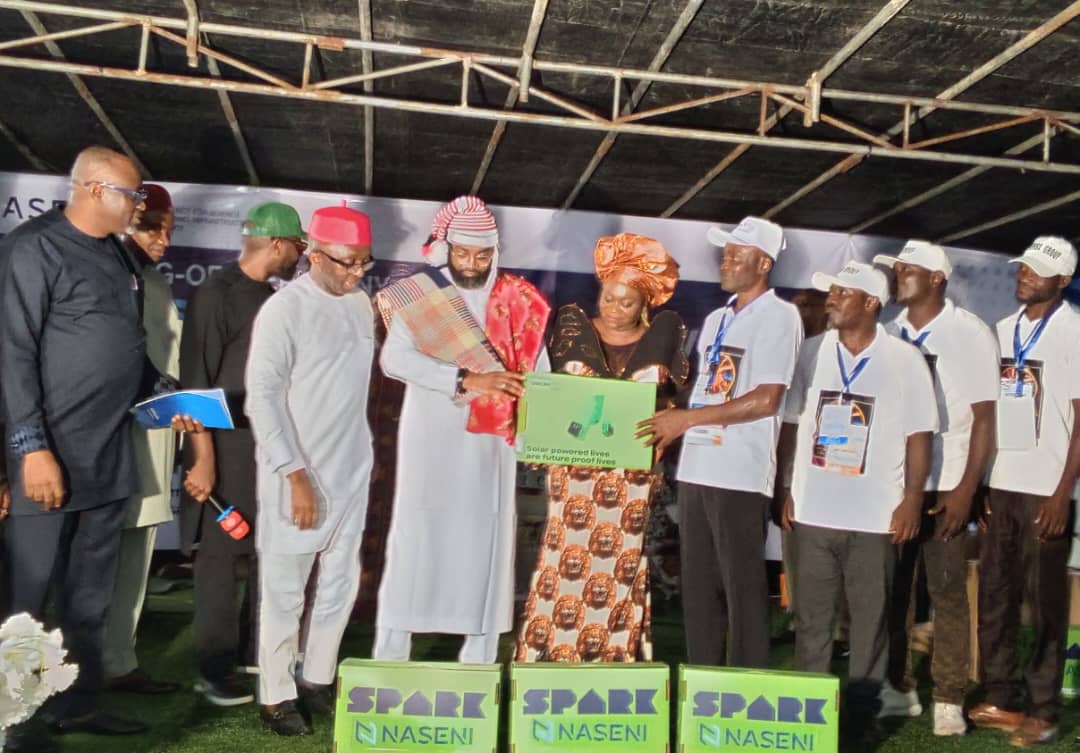
The National Agency for Science and Engineering Infrastructure (NASENI) has taken its Sustainable Empowerment Programme NSEP(Naseni Sustainable Empowerment program)to Ohafia, Abia State, as part of efforts to equip Nigerians with relevant skills, tools and technologies to improve their livelihoods and enhance productivity.
NASENI, a Federal Government agency established in 1992 under the Presidency, is saddled with the mandate of promoting research, development and reverse engineering of capital goods to drive indigenous industrialization.
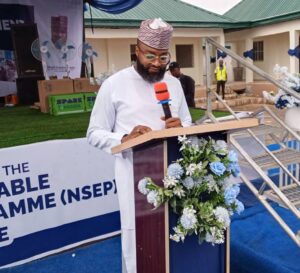
Speaking at the programme held on Thursday, August 27, 2026, at Uma Ukpai Memorial Primary School, Asaga, Ohafia, the Executive Vice Chairman/Chief Executive Officer of NASENI, Khalil Suleiman Halilu, said the initiative was designed to translate science, technology and engineering into practical solutions that improve lives and strengthen communities.
Halilu said NASENI was taking its mandate directly to Nigerians through the NSEP by creating opportunities that would enable beneficiaries to become more productive, build sustainable livelihoods and participate in Nigeria’s growing innovation-driven economy.
He noted that Abia State was particularly significant to the agency because of its reputation for enterprise, creativity, manufacturing and the determination of its people to create value.
According to him, NASENI was focused on moving beyond research to developing solutions that could be used by individuals, adopted by businesses and scaled by industries.
The NASENI boss urged beneficiaries to see the intervention not as a handout but as an investment in their productive capacity, charging them to put the tools and skills acquired to productive use, create value and, where possible, provide opportunities for others.
He added that the agency would measure the impact of its interventions by the number of lives improved, businesses strengthened, jobs supported and communities made more productive.
Halilu commended Governor Alex Otti for his support and warm reception, while acknowledging the Ministry of Finance Incorporated (MOFI) and other partners for their collaboration in making the programme possible.
He said NASENI would continue to take the NSEP to communities across Nigeria to ensure that the benefits of science, engineering and innovation translate into tangible opportunities for Nigerians.
Speaking at the event, the Managing Director/Chief Executive Officer of the Ministry of Finance Incorporated (MOFI), Dr. Armstrong Ume Takang, an illustrious son of the Ohafia community, commended NASENI CEO Khalil Suleiman Halilu and his team for bringing the empowerment initiative to the community.
Takang said the programme would go a long way in improving the livelihoods of the people, describing the intervention as a demonstration of the impact that strategic partnerships could have on communities.
He also expressed appreciation to President Bola Ahmed Tinubu for appointing him to his current position as CEO of MOFI, promising to make the best use of the opportunity to attract meaningful development to his people.
According to him, President Tinubu believes that anyone fortunate to occupy a top position should remember where he came from and use his position to attract meaningful development to his community.
Takang said, “If you are the only rich man in your village or community, you are indeed a poor man.”
He therefore urged those who had the privilege of occupying positions of influence to use their positions to improve the lives of their people and contribute to the development of their communities.
He particularly commended Governor Alex Otti for what he described as the good works being done across Abia State, especially in the area of infrastructure.
Recalling his experience during the burial of his late father in 2012, Takang said the deplorable condition of roads in the community at the time made movement difficult.
He, however, noted that the situation had changed significantly under the Otti administration, saying many roads in his community had been reconstructed by the present administration.
Takang also revealed that the new standard primary school he attracted to his Asaga Ohafia community through his relationship with NASENI would soon be commissioned, adding that Governor Otti would be present at the commissioning.
Also speaking, the Director-General of the Greater Ohafia Development Authority (GODA), Elder Engr. Obinna Odum, commended NASENI for bringing its digital empowerment initiative to the people of Ohafia.
Odum described the initiative as a significant intervention capable of equipping young people and other members of the community with relevant digital skills needed to thrive in today’s technology-driven economy.
He noted that initiatives of this nature would not only expose beneficiaries to new opportunities but also enable them to acquire practical skills that could make them self-reliant, create jobs and contribute meaningfully to the economic development of the community.
The GODA Director-General expressed appreciation to the management of NASENI for considering Ohafia as one of the communities to benefit from the programme, stressing that empowering people with knowledge and skills was more sustainable than providing temporary relief.
As part of the programme, beneficiaries received NASENI energy-efficient cooking stoves and solar-powered fans.
Takang urged the beneficiaries to make the best use of the items, while also encouraging them to acquire relevant skills and knowledge that would improve their individual capacities and livelihoods.
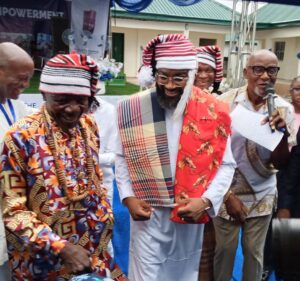
The highlight of the event was the conferment of a traditional title on NASENI CEO, Khalil Suleiman Halilu, by the Ezeogo of Ohafia, to the admiration of guests and other dignitaries present.
The event was attended by traditional rulers, top personalities from the Federal Government, community leaders and other stakeholders.
Do you have an information or event or story for stannews to publish or cover? Kindly Call us 08166404519 or send us message on Whatsapp number 08166404519
National News
Kanu’s Case Goes Beyond One Man, FG Must Address Root Causes of South-East Agitations- Rep Aguocha
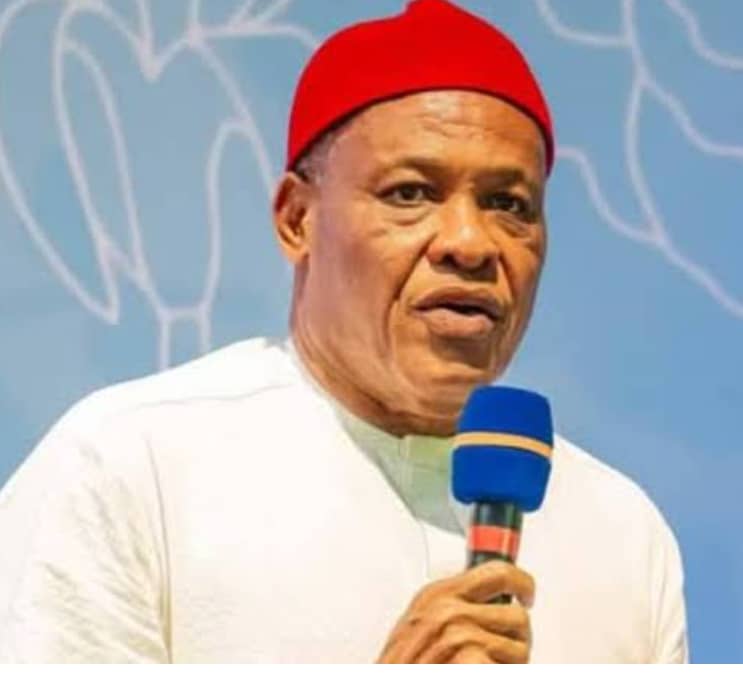
The member representing Ikwuano/Umuahia Federal Constituency in the House of Representatives, Hon. Obi Aguocha, has said the case involving detained Indigenous People of Biafra (IPOB) leader, Nnamdi Kanu, goes beyond one individual, urging the Federal Government to address the underlying grievances fuelling separatist agitations in the South-East.
Aguocha made the remarks while speaking during a radio programme on Rapid FM, Umuahia, where he discussed his advocacy for justice and his involvement in Kanu’s case.
The lawmaker said his intervention was not solely about Kanu but was driven by the need to promote fairness and justice within Nigeria’s criminal justice system.
According to him, the issues surrounding Kanu’s case are connected to broader concerns about the treatment of people from the South-East and the circumstances that have contributed to the persistence of separatist sentiments in the region.
Aguocha argued that the Federal Government must engage honestly with the grievances underlying the agitation for Biafra, stressing that the issues would continue to resurface if their root causes were not properly addressed.
He maintained that addressing the concerns would require more than focusing on individual cases, but also a deliberate effort to understand the frustrations and grievances that have contributed to the agitation.
The lawmaker said his advocacy was therefore aimed at ensuring that justice was served while also drawing attention to the wider issues affecting the South-East.
Aguocha expressed appreciation for the recognition he had received from Kanu’s family and others over his role in the matter, describing it as a validation of his commitment to justice.
He maintained that the Federal Government should pursue a fair and constructive approach to the issues surrounding the South-East, arguing that lasting peace and national unity would depend on addressing legitimate grievances.
Aguocha said his position was rooted in the belief that justice should be applied fairly to all Nigerians, irrespective of their region or circumstances.
He urged the government to look beyond the immediate legal issues surrounding Kanu’s case and consider the broader implications for peace, unity and development in the South-East.
National News
AMNESTY INTERNATIONAL CALLS FOR END TO IMPUNITY, UNLAWFUL ABDUCTIONS, DETENTION, KILLINGS IN SOUTH-EAST
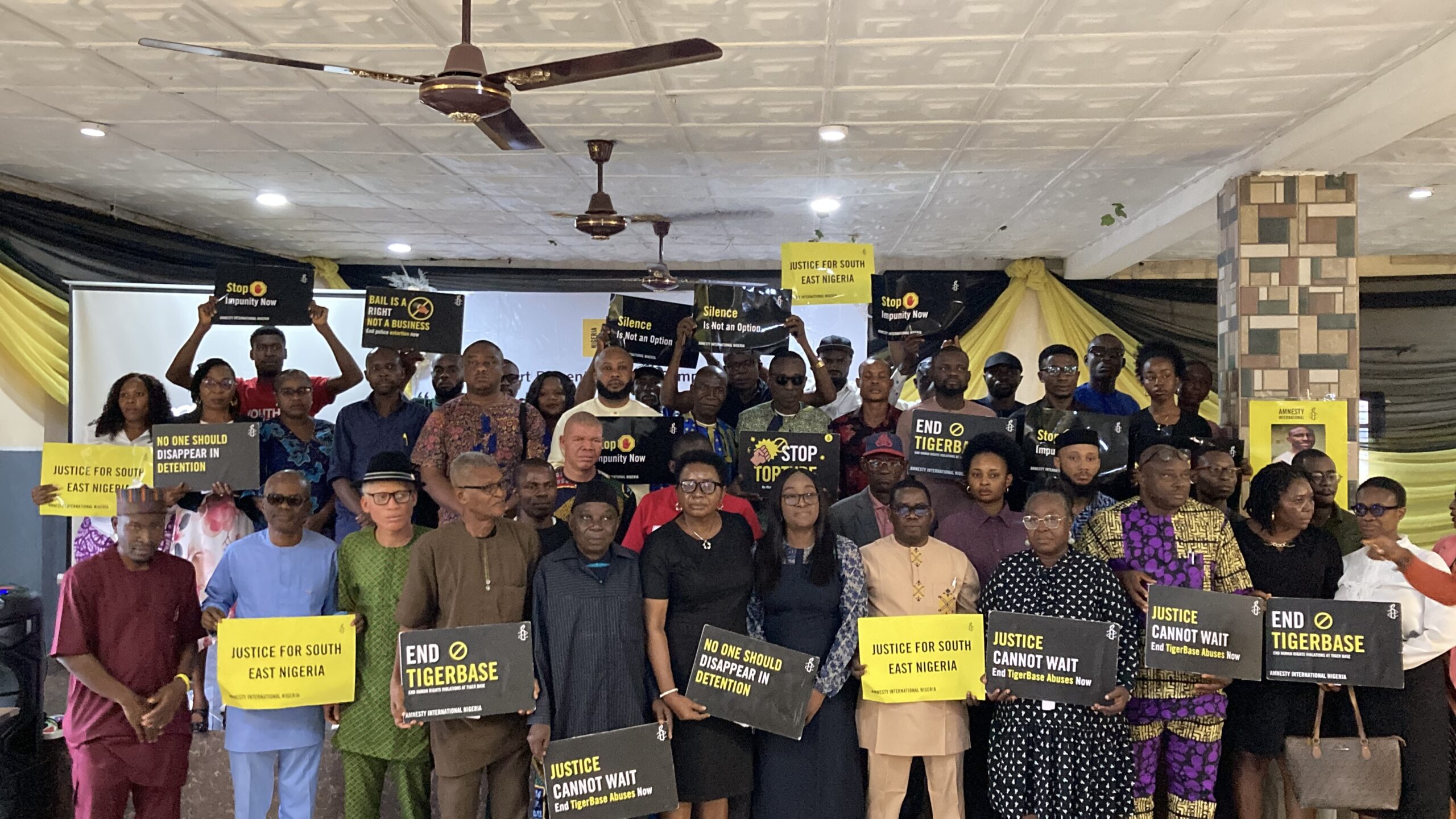
Amnesty International has called on governments, security agencies and other stakeholders to take urgent steps to end alleged unlawful abductions, arbitrary detention, torture and killings by security operatives in the South-East.
The call was made in Umuahia, Abia State, during the re-launch of Amnesty International Nigeria’s human rights reports, including “A Decade of Impunity: Attacks and Unlawful Killings in South-East Nigeria” and “Tiger Base of Atrocities: Human Rights Violations by Nigeria Police Anti-Kidnapping Unit in Owerri.”
In her opening remarks, Benedicta Ofili, Finance and Office Manager at Amnesty International Nigeria, welcomed government representatives, civil society organisations, lawyers, activists, security officials and community leaders to the event.
Ofili said Amnesty International, as an independent global human rights movement, is committed to research, advocacy and mobilisation aimed at documenting human rights abuses, protecting human dignity and ensuring accountability.
She said the organisation’s report documented at least 1,844 deaths between 2021 and mid-2023 amid violence involving non-state armed groups, state-backed outfits and security operations across the South-East.
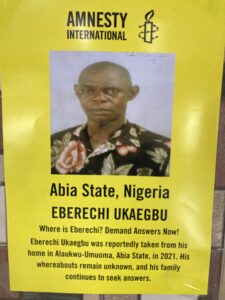
She also highlighted allegations of arbitrary detention, torture, enforced disappearances, extortion and deaths in custody, particularly involving the Anti-Kidnapping Unit popularly known as Tiger Base.
According to her, insecurity has also had significant socio-economic consequences, including displacement, disruption of education, loss of livelihoods and restrictions on freedom of movement arising from sit-at-home orders.

Ofili called for independent investigations into alleged human rights violations, prosecution of suspected perpetrators, reparations for victims and their families, and stronger accountability by state and federal authorities.
The Attorney General and Commissioner for Justice, Abia State, Barr. Ikechukwu Uwanna, represented by Barr. Chinenye Onyemanonu, said the Abia State Government has zero tolerance for human rights violations and abuses.

One of the victims abducted by security personnel
He explained that although the Ministry of Justice cannot direct the police on how to carry out their duties, the government has established mechanisms to monitor and address cases of alleged human rights violations.
According to him, complaints referred to the Office of the Attorney General are forwarded to the Citizens’ Rights Department for investigation and appropriate action.
He cited a recent case involving a family whose members were allegedly detained for more than six months, resulting in one of the daughters losing an academic year. He said the Ministry intervened by engaging the affected persons and making recommendations for appropriate action.
Barr. Uwanna urged stakeholders to sustain collaboration in the protection of human rights and commended the administration of Governor Alex Otti for what he described as significant reforms in the justice sector.
During the presentation of “A Decade of Impunity: Attacks and Unlawful Killings in South-East Nigeria,” Amnesty International examined alleged human rights abuses involving the military, Department of State Services (DSS), police and Ebubeagu security personnel between 2016 and 2024, with particular focus on incidents recorded from 2021 to 2024.
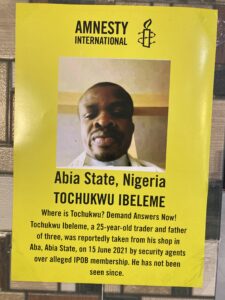
The organisation said it had documented more than 1,800 deaths across the region, as well as cases of people allegedly abducted or forcibly disappeared after being accused of links to the Indigenous People of Biafra (IPOB).
The report also highlighted the impact of insecurity on livelihoods, education and freedom of movement, particularly in Abia and other parts of the South-East.
Amnesty International further raised concerns over alleged abuses at the Tiger Base/Tiger Gate detention facility in Imo State, where some persons arrested in Abia were reportedly transferred.
The organisation said it interviewed 23 former detainees, including 14 women, and documented allegations of torture, poor detention conditions and deaths in custody. It said three of those interviewed reportedly died following their detention.
Amnesty International called for investigations into the alleged abuses, improved detention conditions and accountability for anyone found responsible.
Some relatives of persons allegedly abducted by security operatives also shared emotional accounts of their loved ones’ arrests and prolonged disappearance.
Miriam Onyema, in tears, recalled how her husband, Kingsley Chinedu, was allegedly arrested on April 25, 2021, at Hospital Junction in Imo State. She said repeated efforts to locate him or secure his release proved unsuccessful after he was allegedly labelled an IPOB member.
Esther Chinedu said her husband, Pastor Godspower Chinedu, was arrested in 2022 and that the family had not seen him since. She said several attempts to locate him at police detention facilities had been unsuccessful.
Caroline Chukwuma also narrated how her husband, Chukwuma Nwokike, was allegedly abducted in 2021 at St. Paul Junction, Aba, and detained at the CPS Aba. She said she and her lawyers were denied access to him and were later informed that he had been transferred to a detention facility in Abuja.
Chinwendu Chidiebere said her husband, Chidiebere Ekwe, was arrested at his workshop in Aba on June 22, 2021, and taken to CPS Aba, where the family was allegedly denied access to him.
An elderly man, Nicolas Ejekwu, tearfully recounted the arrest of his two sons, Obinna and Onyebuchi, by soldiers at his home. He said he later received information that they had allegedly been tortured and killed and that their bodies were taken to the Federal Medical Centre mortuary, Umuahia.
He also revealed that more than 50 bodies of youths allegedly killed by security agencies on suspicion of being members of IPOB were found at the mortuary.
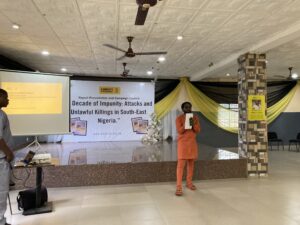
Cecilia Nmaoche also said her son, Christian Ifeanyi, was allegedly abducted by security operatives in 2022 and had not been seen or heard from since.
The relatives appealed to Amnesty International and the government to help locate their loved ones and ensure that anyone arrested is either released or brought before a competent court rather than being held for years without trial.
A human rights activist, Samuel Agwu, who spoke on behalf of more than 30 persons allegedly subjected to unlawful detention, called on Amnesty International Nigeria and other human rights organisations to intensify efforts to address alleged human rights violations in the South-East.
Agwu said he had facilitated the release of several persons allegedly detained on suspicion of being members of IPOB.
He alleged that many people arrested by security agencies in the region had been labelled IPOB members without sufficient evidence, with some reportedly held in police and military detention facilities for prolonged periods.
He expressed concern over allegations of torture and other forms of inhumane treatment, as well as cases of people who allegedly disappeared after being taken into custody.
Agwu urged human rights organisations to go beyond documenting cases and ensure that victims and their families have access to justice, legal representation and appropriate remedies.
He also called on South-East governors, security agencies, civil society organisations and other stakeholders to work together to address what he described as a culture of impunity allegedly perpetrated by some security personnel in the region.
“We cannot continue to remain silent when people are arrested, detained and allegedly tortured simply because they are suspected of having links with a particular group. Every person has the right to due process, fair hearing and humane treatment, regardless of the allegations against them,” Agwu said.
Amnesty International therefore urged relevant stakeholders and government authorities to take concrete steps to end unlawful abductions, arbitrary detention and killings allegedly carried out by security operatives in the South-East.


GOVERNOR OTTI FELICITATES MEMBER REPRESENTING IKWUANO/UMUAHIA FEDERAL CONSTITUENCY, HON. OBI AGUOCHA ON HIS BIRTHDAY.

Rt. Hon. Obi Aguocha Engage Labour Party Ward Chairmen in Ikwuano

APC Abia Disowns Youth Leader’s Statement Calling For Suspension Of City Boys Movement
-
Fashion9 years ago
These ’90s fashion trends are making a comeback in 2017
-
Entertainment9 years ago
The final 6 ‘Game of Thrones’ episodes might feel like a full season
-
Fashion9 years ago
According to Dior Couture, this taboo fashion accessory is back
-
Entertainment9 years ago
The old and New Edition cast comes together to perform
-
SPORTS9 years ago
Phillies’ Aaron Altherr makes mind-boggling barehanded play
-
BUSINESS9 years ago
Uber and Lyft are finally available in all of New York State
-
SPORTS9 years ago
Steph Curry finally got the contract he deserves from the Warriors
-
Entertainment9 years ago
Disney’s live-action Aladdin finally finds its stars